A note on building things for people who can’t pay you back yet.
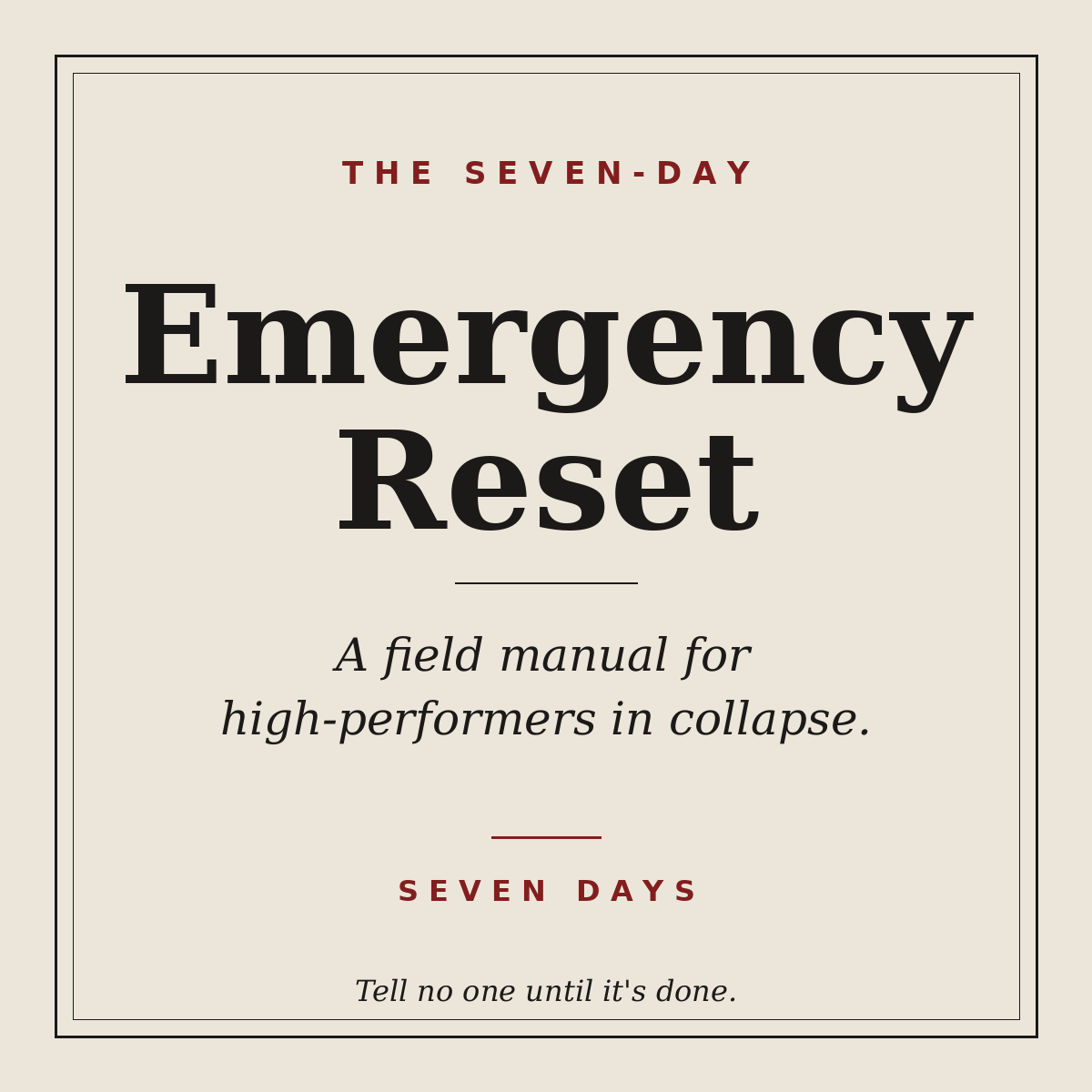
I launched a product this week on Gumroad called The 7-Day Emergency Burnout & Financial Reset. It’s a 17-page field manual for high-performers in collapse — the specific kind of collapse where burnout and financial crisis happen at the same time and feed each other.
I priced it at zero.
Not “free with email capture.” Not “free trial.” The slider on the Gumroad page starts at zero and you can drag it as high as you want. The suggested amount is €15. The minimum is nothing. If you put a zero in the box, you get the entire manual, no paywall, no gate, no follow-up email asking for an upgrade.
I want to explain why, because the decision is less generous than it looks.
The audience can’t afford €15.
I wrote this manual because I needed it.
As I write this, I am staring down a negative bank balance, negotiating with three creditors, and deciding which software subscriptions to cancel so I can survive the month. The manual is a protocol I built for myself, refined into something general enough to be useful to anyone in the same situation. I know the audience because I am the audience.
And the audience cannot pay €15.
That is not a marketing hypothesis I am hedging. It is the central, structural fact of the product. The people who most need a 7-day emergency protocol for burnout-plus-money-crisis are, by definition, people who do not have €15 of disposable income this week. Anyone telling them “this product will help you” while charging €15 is making a promise they have already broken at checkout.
The standard solution to this in digital products is the freemium model: give them Chapter 1, charge for Chapter 2 through 7. I considered it. I rejected it. Day 1 of an emergency protocol is not where the value compounds. The value compounds over the full week. Splitting the manual into a paid back-half would be selling the audience exactly the second half they needed and could not afford.
So I gave them the whole thing. Pay what you can. Pay nothing.
The honor system is a structural decision, not a sentimental one.
The mechanic is simple: download the manual at zero, use it, and if it helps you land a win — a client conversation, a payment plan, a week where you finally slept — come back to the Gumroad page and pay what it was worth to you.
A few people have asked whether I expect this to work financially. Honest answer: I expect most people who download for free never to come back. That is fine. The honor system is not a clever pricing strategy disguised as generosity. It is a generosity strategy that happens to be the only honest pricing structure for this specific audience.
The people who come back and pay are paying retrospectively, from a position of recovered cash flow, for value they have already proven to themselves. Those payments will be small. They will be irregular. They will not pay my rent. I know this.
What the honor system does do is preserve the integrity of the product’s positioning. It says, clearly: the manual is not a lead magnet for a more expensive course. It is not a teaser for a coaching package. It is the actual thing. The complete protocol. If you can pay, pay. If you can’t, take it, use it, and we are even.
That is the only configuration of this product that does not insult the audience it was built for.
On building from inside the problem.
There is a particular kind of dishonesty in the burnout-content market right now. The protocols are written by people in clean Notion templates and green-smoothie kitchens, by coaches whose own collapse was either a long time ago or a marketing biography. The advice is reasonable. The voice is wrong.
I am not above the situation I am writing about. I am inside it. The manual was drafted on days I could barely get to the desk and edited on days I could. The financial triage chapter was written between actual calls to actual creditors. The “Identity Sentence” exercise in Day 5 — I am the kind of person who handles things in daylight, not at 3am — is mine, not a hypothetical.
This is not a virtue. It is just the only material I had. But it makes the product specific in a way that polished burnout content rarely is, and it changes what I am willing to charge. You cannot, in good conscience, sell an emergency protocol at a price point that excludes the people in the actual emergency.
What I expect to happen.
The metrics I am watching:
– How many free downloads.
– How many of those convert to a retrospective payment, and at what average.
– Whether the honor-system mechanic generates more inbound interest than a standard €15 price would.
– Whether anyone in the actual target audience writes back to say it helped.
The honor-system framing is unusual enough on Gumroad that it functions as a piece of content in itself. The story of why the product is priced this way will probably travel further than the product page. That is fine. The story and the product are pointing at the same thing.
The manual.
Seven days. Seventeen pages. Pay what you can, or nothing at all.
→ tripwin.gumroad.com/l/qmbrld
If you are not in the kind of trouble it was written for, share it with someone who is. That is the only marketing it needs.
Until it’s done, tell no one.
— Davide
A field manual for high-performers in collapse. Day 1 starts tonight.