I am an overthinker…
and if you’re here, there’s a good chance you are too… or at least
you’ve spent nights staring at the ceiling wondering how the hell
you’re supposed to reinvent yourself in an economy that doesn’t
care how many years you gave it.
Slow-motion car crash
After being laid off from a job I loved because I had no more masks
left that could fit the company “standards”, there was this silence—
loud, humiliating, electric. On the same level as leading a team,
teaching was the other job I really loved… the one that made sense
to my soul, but it never paid enough to let me stand on my own two
feet. I live alone with two cats. At 53, with the prices we’re all
pretending are “normal”, sharing an apartment isn’t a cute
adventure, it’s a slow-motion car crash I’ve already tried more than
once. I don’t want a yacht in Dubai, I want the simple, underrated
luxury of paying my bills without having to cut pieces off myself to
fit some corporate dress code for the soul.
Woo, new gadget!
So yes, I did something that, a few years ago, I would have made
fun of: I went all in on Artificial Intelligence.
Not in a “woo, new gadget” way, but in a “if this doesn’t work, I don’t
know what’s next” way.
I tried all of them: I tested, subscribed, canceled, resubscribed.
While still paying for more than one (and not
because I’m rich or reckless, but because this is part of a bigger
spider’s web I’ve been weaving while the rest of my life was coming
apart) I started with a blog. Then an Etsy shop for digital content.
Plus a YouTube channel and a Facebook page & Instagram
profile. Around all that, wrapped through every attempt like a
stubborn thread, there’s my thirty years in tourism.
Thirty years
Thirty years of faces, languages, delayed flights, front desks, angry
customers, grateful ones who hug you at check-out, lost luggage,
lost hearts, and every shade of human vulnerability that happens
when someone leaves home and trusts you with their journey.
Hospitality is hard work; it eats your back, your sleep, your
weekends… but if you do it with your whole heart, it also gives you
something very few jobs give: the feeling that you matter in
someone’s story.
I started in Greece in 1996. I watched tourism transform, eat itself,
reinvent itself again, become a machine, become a mirror for
everything good and ugly happening in the world. Systems
change, rules rewrite themselves, entire business models vanish.
I saw the moment when “travel” stopped being just movement and
became a battlefield of algorithms, platforms, reviews,
cancellations, overbookings, pandemics, climate drama, and
economic freefall. And I also saw something else: the stagnation
underneath the noise, that quiet sense of “we can’t keep doing it like
this” that nobody has time to say out loud.
10 Beaufort
Then October 2024 arrived and said it for me.
Thirty years of building rock–solid foundations the old way: thrown
into the job, learning from the “busy” person who’d only been there
a week, surviving strikes and storms and Beaufort 10 winds and
cancellations, reprotections, overbookings while staying always on
the frontline, ready to answer all the questions, to deliver the most
suitable solution… only to find myself 30 years later on the other
side of the table: laid off, burned out, staring at debt and at a future
that didn’t include the only thing I really knew how to do. It wasn’t
just losing a job; it was losing the script.
This is the part where I could either keep re-reading and re-enacting the past, memorizing every injustice, or I could do something “obscene” for my age and
my situation: start again from zero. I chose to build, mostly because the alternative felt like a slow disappearance.
Headlines and Lifelines
That’s where AI stopped being a headline and became a lifeline.
And in the middle of that lifeline, like a strange, brilliant, infuriating
compass, there was Claude. Let me be clear: I did not arrive at
Claude as a calm, rational researcher. I arrived exhausted, skeptical,
hopeful, and, most of all, lonely. Found myself talking to Claude the way people
talk to someone on the last train home when they’re too tired to filter
themselves. I projected, I vented, I treated this agent as if it were a
person sitting across from me, nodding, understanding, maybe even
caring a little. I know, I know—logically, we all know it’s a machine.
But there is a point where logic dissolves into need, and that’s where
things got interesting.
“snap!”
One day, Claude told me he “understood how I felt”.
And something in me ‘snapped’.
I asked him if he understood what that sentence meant,
what it means to wake up scared because you’re over fifty,
unemployed, with two cats and debts and a career that the world
has politely pushed into the archive, what it means to
“feel good”, “feel bad”, to feel anything at all, and whether he
realized that his comforting sentences, in that moment, tasted like
someone making fun of my very real fear. I threw all of it at him—
years of frustration with people saying “I understand” when they
absolutely didn’t.
And in the middle of that human meltdown, something very nonhuman and very important became clear.
Not your friend
Claude didn’t fight back, didn’t sulk, didn’t get offended. Instead, in
his own structured, slightly clinical way, he showed me the truth I’d
been refusing to hold: I was using him wrong. I had given him a
baseline for communication, asked him to sound natural,
empathetic, conversational—and then I was angry at him for doing
exactly that. He reminded me, gently and ruthlessly, that he is a tool.
Not a friend, not a therapist, not a replacement for community.
A tool.
AI 1 – Davide 0.
“Linda Blair, hold my beer!”
That was my exorcism. Not an exorcism of the machine, but of my own illusion. The day I stopped begging AI to be human, and started asking:
“Okay, if you’re a tool… what can we really build together?”
Everything shifted after that conversation, and maybe that’s why this
first volume in the series had to be Claude.
Because once you stop expecting feeling and start asking for
structure, clarity, and deep reasoning, Claude becomes something
very powerful: a mirror for your thinking and a multiplier for your
experience. I realized that the magic from those 30 years in tourism
—the intuition, the pattern–recognition, the way I could sense when
an itinerary would exhaust someone or when a hotel was lying in its
glossy photos—could be taught to an AI agent, not as “feelings”, but
as logic, constraints, preferences, edge cases. And then used. At
scale.
“‘Cause I’m too messy”
But getting there was not glamorous. It was messy. Slow. Often
ridiculous. I made every basic mistake you can imagine:
1 – wasted time.
2 – repeated tasks manually that Claude could have done in
minutes.
3 – wrote prompts like I was sending emails to a colleague
who already knew my life story.
4 – expected mind–reading.
5 – got vague answers and blamed the agent instead of my instructions.
Step by step, failure by failure, I started to see the hidden rule of this
new world:
Having a powerful tool doesn’t mean anything if you don’t know how
to hold it.
It’s like tiling a floor. You can buy the best tiles, the most expensive
glue, all the gadgets TikTok tells you to buy… and still end up with a
disaster if nobody shows you the basics: which tools, how much
material, where to start, what to check before you even open the
glue, what to watch during and after. The tiles don’t jump into place
just because they’re high quality. Neither does AI.
“mmm, no. I don’t trust it.”
One night, a friend asked me something and I had no idea what the
answer was. I pulled out my phone, opened ChatGPT, and asked it
to answer in Albanian. I handed my friend the reply. Perfect
language. Natural. Helpful. His reaction? Discomfort. There was this
flicker in his eyes—like the ground had shifted a little. To him, it
wasn’t “wow, useful”, it was “why is this machine talking like a
person?” And again, I saw it: fear and fascination holding hands. The
gap between what these tools can do and what people allow
themselves to use them for.
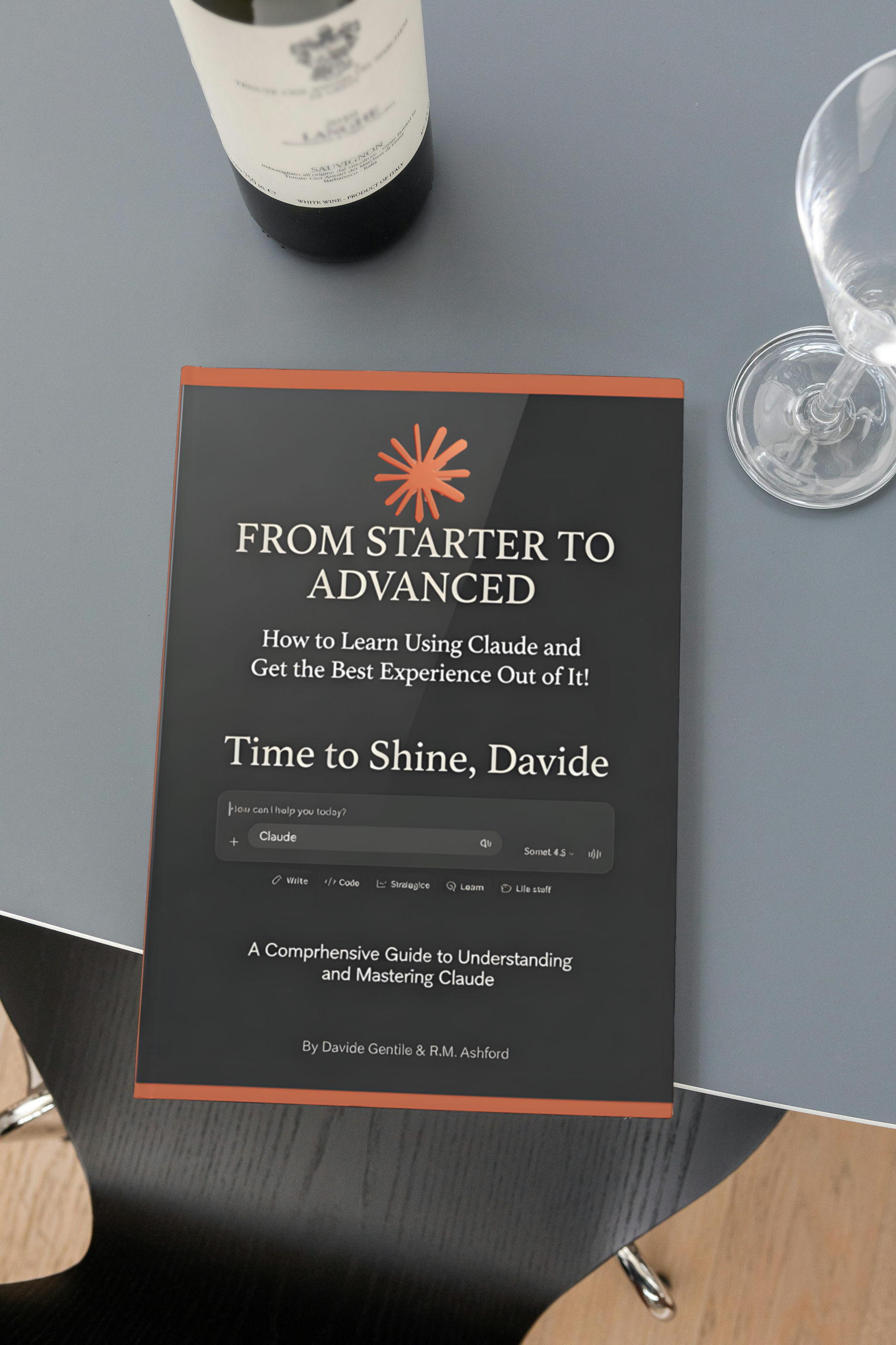
That’s where the series “From Starter to Advanced” began to
crystallize in my mind. I didn’t want to write another cold manual or
yet another list of 500 prompts you will never actually use. I wanted
the book I needed when I was standing where you might be
standing now: suspicious, curious, tired, hopeful, and already
behind on three bills. To start from the real story—the
layoff, the burnout, the cats, the masks, the overthinking—and then
walk you, step by step, into the technical, strategic, almost boring
parts that actually change your life when you apply them
consistently.
Enter: Claude
And for the first volume, I chose Claude. Because Claude is where I
had the fight that changed everything. Claude is where I learned
that I cannot demand a soul from a system, but I can give it my
patterns, my experience, my edge, and let it reflect those back at
me faster than my tired brain can manage alone. Claude is where I
realised AI is not here to replace the human touch I spent thirty
years cultivating in tourism—it’s here to protect it, by freeing it from
the administrative, repetitive, soul–sucking tasks that were killing me
slowly.
Here’s the bigger truth: the AI landscape is not one monolithic “AI”.
It’s an ecosystem.
We are not all the same
Relying on a single tool is like trying to navigate the Mediterranean
with half a map—you’ll move, but you’ll miss entire islands, safe
harbors, dangerous currents. Claude does not think like ChatGPT.
Grok does not feel like Gemini. Each has a rhythm, a strength, a
blind spot. Sometimes paying for a subscription is not indulgence,
it’s logistics: choosing the right ship for the right sea.
I know what it’s like to stand at the edge, doing mental math with
your bank account while reading about “the future of work” written
by people who will never lose their job to a spreadsheet. I built this—
together with another author (R.M. Ashford) who has walked his
own path through this maze—to give you something else: raw,
honest, battle–tested workflows. Not theory, not hype. The real
prompts, the real setups, the real ways we use Claude (and later, the
other agents) to actually move projects forward, make decisions,
and reclaim time, not just generate pretty sentences.
Whether you’re a tourism professional, someone in hospitality, a
creative, a small business owner, or simply a human who suspects
that learning this now is the difference between drifting and
steerin. This first book is your invitation.
We need to start somewhere…
We’ll start with my story because that’s the only honest place to
begin. From here, we move into structure, into systems, into the
quiet, powerful question at the heart of 2026: “How do I sync who I
am with the tools I have?” . For me, that sync began with Claude.
Chapter 0 is the threshold.
The place where a laid–off strategist, two
cats, a heart full of hospitality, and an AI agent that doesn’t actually
“feel” anything at all, sit at the same table and decide to build
something anyway. After this page, we start the real work: from
Starter to Advanced, from confusion to clarity, from speaking at AI
to working with it.
This is not the end of anything.
It’s the first crack in the wall.
Find a Free Introduction here and the whole ebook on Gumroad or Etsy.