Category: Creative Process

This is how things get done

  • Being busy. And why it is good.

    Being busy. And why it is good.

    2 books, several new songs, while working 8 hours a day, reviewing, cutting, publishing, auditing, producing, and still haven’t got the time to let an agent post on my behalf.

    No announcements. No launches. Not too much noise.

    Just putting the work where it can be found.

    Two books

    The last few weeks produced two very different books under A Quiet Work Press.

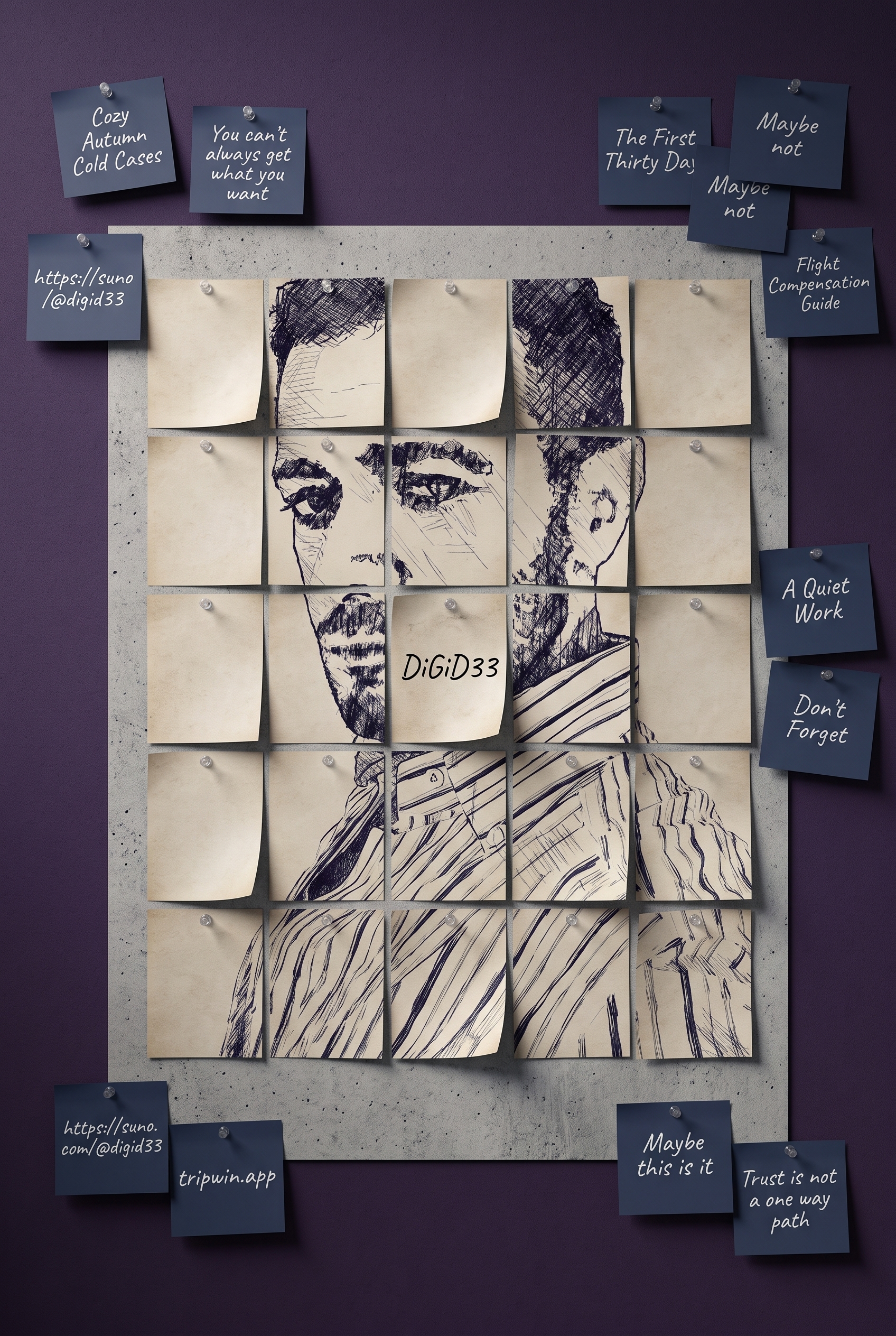
    Cozy Autumn Cold Cases

    Cozy Autumn Cold Cases: 25 Cozy Whodunit Puzzles, Hidden Clues & Logic Mysteries for Armchair Detectives is an interactive cozy mystery puzzle book published as DiGiD33.

    Twenty-five self-contained autumn mysteries. Hidden clues. Logic. Observation. Deduction. The kind of book made for people who like to stop before the answer and decide what really happened.

    Find Cozy Autumn Cold Cases on Amazon

    The First Thirty Days

    The First Thirty Days: What to Do When Someone Dies: Handling the Accounts, the Admin and the Institutions That Say No is published under my name, Davide Gentile.

    More practical rather than inspirational: what happens when grief collides with passwords, accounts, subscriptions, banks, utilities, paperwork, institutions and the strange administrative reality that follows loss.

    Find The First Thirty Days on Amazon

    The music: DiGiD33

    Music has become another part of the same work.

    Not background music for a product. Not content made because an algorithm asked for content. Songs, spoken pieces, cinematic experiments, melancholy, noise, silence, voices, strings, atmosphere, things that sometimes begin as a sentence and end somewhere I did not expect.

    I publish this work as DiGiD33.

    Some songs are built around atmosphere first. Others around words. I am less interested in forcing everything into one genre than in finding the sound that belongs to the idea.

    The process has become increasingly specific: cinematic arrangements, long introductions, spoken-word structures, male and female voices used almost as characters, restrained percussion, piano, cello, strings, static, breathing, silence.

    I am still testing what this musical identity is allowed to become. That is probably the point.

    All current music: DiGiD33 on Suno

    And then the images started moving

    The YouTube channel is where some of that music starts acquiring another layer: image, sequence, atmosphere and narrative.

    The visual side is not there to explain the song. If anything, I prefer when it creates another question.

    Some of these pieces sit closer to short films than conventional music videos. I like that territory: fragments, memories, unresolved images, the feeling that something happened before the first frame and continues after the last one.

    Watch everything: DiGiD33 on YouTube

    The practical side is still here

    TripWin.app is still part of the work: a free, DIY-friendly way to understand flight compensation and passenger rights without handing a percentage of a valid claim to a claims company.

    The Flight Compensation Guide: How to Turn Travel Chaos Into a Win is also on Amazon, covering EU261, US DOT rules, cancellations, delays, denied boarding and what to do when travel goes wrong.

    Find the Flight Compensation Guide on Amazon

    A Quiet Work

    This blog started as one thing and kept becoming more things.

    Travel rights. Digital products. AI experiments. Books. Music. Personal work. Things that fit neatly together and things that absolutely do not.

    I wrote before about everything I had built so far. Since then, the pile kept growing.

    The practical side is still here too. My flight compensation work, TripWin.app, the digital products and the travel material still belong to A Quiet Work. They are not being replaced by music or books.

    The point was never to become one thing.

    The point was to keep making things that deserved to exist.

    Where everything is now

    What is DiGiD33?

    DiGiD33 is the name I use for my current independent music, visual and selected publishing work: original songs created and developed with AI-assisted tools, cinematic and experimental music, spoken-word pieces, YouTube visuals and books published through A Quiet Work Press.

    Is the music AI-generated?

    AI is part of the production process. The direction, lyrics where used, structure, selection, editing, iteration, visual identity and final decisions are mine. I use tools such as Suno as instruments inside a larger creative process rather than as a substitute for having an idea.

    Where can I listen to DiGiD33?

    The current catalogue is on Suno, with selected pieces and visual work on the DiGiD33 YouTube channel.

    Where are the books published?

    The books are published through Amazon KDP under A Quiet Work Press, using either DiGiD33 or Davide Gentile depending on the project.

    What is TripWin?

    TripWin.app is my free travel-rights tool built to help travellers understand whether EU261 or related passenger-rights rules may apply and take the next step themselves.

    No announcements. No launches. Not too much noise.

    Just the work, finally in one place.

  • Everything I’ve Built So Far. And Why I’m Not Stopping.

    Everything I’ve Built So Far. And Why I’m Not Stopping.

    There’s a phrase I’ve kept close for a long time.

    Until it’s done, tell no one.

    I’ve mostly honoured it. I built quietly, launched quietly, fixed things quietly. But every now and then a moment comes where the right thing to do is the opposite: stop, look back, and say out loud what’s actually been done.

    This is that post — my whole solopreneur journey so far, in one place. The guide, the products, the music, the channels — and one piece of news.

    Grab a coffee. This one is long on purpose.

    It started with a guide

    I spent three decades in and around the travel industry, watching the same scene repeat itself: a flight gets cancelled, a hotel “walks” a guest, a ferry never leaves — and the traveller standing at the desk loses money for one reason only. Nobody ever told them the rules. The airline knows them. The hotel “mostly” knows them. The traveller is, statistically most of the time, the only one in the conversation who doesn’t, and they’re counting on exactly that.

    So I wrote the rules down.

    The Flight Compensation Guide: How to Turn Travel Chaos Into a Win is a plain-language playbook for when travel goes wrong, on both sides of the Atlantic — EU 261, US DOT rules, overbooking, cancellations, hotel walks, cruise disruptions, and a one-page action plan for the exact moment it all kicks off.

    It went out into the world step by step, the quiet way:

    First on Etsy, last year. That was the proving ground — a digital guide, no middlemen, just the work meeting its first readers. 👉 The Flight Compensation Guide on Etsy

    Then on Gumroad, where the rest of my digital work already lives. 👉 The Flight Compensation Guide on Gumroad

    And now on Amazon — as a real paperback you can keep in the glovebox or the carry-on, and as a Kindle ebook for less than the coffee you’ll buy at the gate. 👉 Paperback · Kindle

    Same book everywhere. Pick the shelf you prefer.

    And if you read it and it helps you — or you can already see how it would — leave an honest review. A book like this lives or dies on its first reviews, and yours genuinely moves the needle. If it doesn’t help you, tell me that too. I’d rather know.

    The tool that started it all

    Before the book there was TRipWin — my answer to an industry of claim companies that take 25–35% of your compensation for sending a letter.

    TRipWin generates a professional, legally sound EU 261 claim letter for you. Free. No commission. You keep 100% of what the airline owes you. It’s still there, still free, and it will stay that way.

    What else is on the shelves

    The guide isn’t alone. Everything I’ve released is still live, still available:

    The 7-Day Emergency Burnout & Financial Reset — a 17-page field manual for the specific kind of collapse where burnout and money crisis feed each other. I priced it at zero, on the honor system, because the people who need it most are by definition the people who can’t pay for it this week. I wrote about that decision here. Nothing has changed: take it, use it, and if it earns you a win, come back and pay what it was worth.

    Your Soul Blueprint — a free numerology reading generated from your birth data, in eleven languages (yes.. 11. And I am a 7 Life Path). Not a template, not a horoscope. Still evolving until I’m satisfied with its final form.

    The Shop — the ethos you can wear or hold. The “Tell No One” Snapback, a Dad Hat, two mugs, and an eco tote bag. For the people who build in silence and let the results make the noise. I have in mind to make personalized items.. like your lucky number. I can get yours based on your DOB and put it on a Dad Hat or Snapback. It would be cool, we all need some good vibes.

    And everything else on Gumroad, where new practical guides land as they get finished.

    The music

    This one I haven’t told properly yet.

    I love music. I always have. When Suno made it possible, I started the practical way — publishing music I held the commercial use for, and feeding it into Akashic Nocturne: a sleep channel tuned to 432 Hz and 528 Hz, with AI-crafted journeys through lost civilisations, deep space, sacred geometry and the knowledge hidden in the dark. New journeys go up weekly. Close your eyes. The records open.

    From there came the Akashic Sounds Lab, now available on Gumroad.

    And while building all of that, something shifted. I started creating music for my soul — music with lyrics, and with it, a musical identity. On Suno I am DiGiD. A palindrome, and inside it, my whole name and my whole identity. All the songs I am publishing are part of an ecosystem that will be translated in another communication tool soon. There is a story that needs to be told.

    And on the practical side of my life there’s TripWin on YouTube — travel rights, compensation, the stuff that puts money back in your pocket.

    Two channels. Two sides of the same person. I’ve stopped pretending that’s a problem.

    The news: I started a new job this week

    There it is.No further details needed.

    I started a new job to sustain myself economically while I keep pushing the things I believe in.

    Some people will read this as a step back. I don’t. Bills exist. My cats eat every day, remarkably indifferent to my publishing schedule. I have no secret vault, no trust fund, no magic trick I can perform to wake up rich tomorrow (…). What I have is work I believe in and the patience to see it through — and patience is not something I lack.

    A job doesn’t end any of this. It funds it.

    On niches, algorithms, and everyone who knows better

    Here’s where I’m supposed to tell you about my niche.

    Every influencer, every AI, every growth guru points the same way: pick one lane, feed the algorithm, optimize for sales, solve your immediate economic issues first and do the meaningful stuff later.

    I’ve heard it all. I understand it. And I don’t care.

    Not because the advice is wrong — for many people it works. But I am not able to follow instructions mechanically, and I’ve stopped apologising for that. I have many interests. Everything I do, I do for a reason. A travel guide and a sleep frequency channel and a numerology reading don’t fit in one niche, and I’m done trying to make them.

    Here’s the thing nobody puts in the growth threads: I need to be good with myself in order to do anything at all. If I can’t put passion into a thing, the thing makes no sense — it will be hollow, and people can smell hollow from a mile away. So I’d rather build slowly, honestly, across everything that matters to me, than build fast in a lane someone else picked.

    If not now, this work will get the recognition it deserves sooner or later. I genuinely believe that. And in the meantime — I know everything is going to be alright.

    Where to find everything

    One list, no fluff:

    If any of it is useful to you, take it. If it’s useful to someone you know, send it to them. That’s the only marketing any of this needs.

    Until it’s done, tell no one.

    It’s done. Now I’m telling everyone.

    — Davide

  • The Shop Is Open.

    No Fanfare. Just Work.

    There’s a phrase I’ve kept close for a long time.

    Until it’s done, tell no one.

    It’s not about secrecy. It’s about respect — for the work, for the process, for the thing you’re building before the world gets to have an opinion on it. Most people announce. Then they stall. Then they explain why it didn’t happen. I’d rather just show up with the finished thing.

    So here it is. A Quiet Work now has a shop.

    No countdown timer. No “launching soon” page that sits there for eight months. Just a shop, with a product in it, ready to go.

    The first drop: The “Tell No One” Snapback

    I wanted the first product to mean something. Not just another hat with a logo on it — something that says what this brand is about without needing a paragraph of explanation.

    The “Tell No One” Snapback is for the people who build in silence. The ones working on something before anyone knows about it. The ones who don’t post about the goal — they post about the result.

    It’s a premium structured six-panel snapback, flat visor, plastic snap closure. White. Clean. The kind of hat where someone asks “what does that mean?” and you just smile.

    €25. Get it here.

    Why a shop? Why now?

    A Quiet Work started as a blog. Then it became a space where I could share what I’ve learned from 30 years in tourism — practical stuff, not fluff. But I’ve always wanted it to be more than words on a screen.

    The shop is where the ethos becomes something you can hold. Wear. Put on your desk. Every product will connect back to the same idea: do the work quietly, let the results make the noise.

    More products are coming. I’m not going to announce them in advance.

    You’ll know when they’re here.

    One more thing (or 2)

    I also dropped a short on YouTube. No big production — just the vibe.

    👉 Watch it here


    The shop: aquietwork.com/shop

    If you’ve ever thought “I should really stop talking about it and just do it” — this hat might be for you.

  • Why I priced my new product at zero.

    Why I priced my new product at zero.

    A note on building things for people who can’t pay you back yet.

    I launched a product this week on Gumroad called The 7-Day Emergency Burnout & Financial Reset. It’s a 17-page field manual for high-performers in collapse — the specific kind of collapse where burnout and financial crisis happen at the same time and feed each other.

    I priced it at zero.

    Not “free with email capture.” Not “free trial.” The slider on the Gumroad page starts at zero and you can drag it as high as you want. The suggested amount is €15. The minimum is nothing. If you put a zero in the box, you get the entire manual, no paywall, no gate, no follow-up email asking for an upgrade.

    I want to explain why, because the decision is less generous than it looks.

    The audience can’t afford €15.

    I wrote this manual because I needed it.

    As I write this, I am staring down a negative bank balance, negotiating with three creditors, and deciding which software subscriptions to cancel so I can survive the month. The manual is a protocol I built for myself, refined into something general enough to be useful to anyone in the same situation. I know the audience because I am the audience.

    And the audience cannot pay €15.

    That is not a marketing hypothesis I am hedging. It is the central, structural fact of the product. The people who most need a 7-day emergency protocol for burnout-plus-money-crisis are, by definition, people who do not have €15 of disposable income this week. Anyone telling them “this product will help you” while charging €15 is making a promise they have already broken at checkout.

    The standard solution to this in digital products is the freemium model: give them Chapter 1, charge for Chapter 2 through 7. I considered it. I rejected it. Day 1 of an emergency protocol is not where the value compounds. The value compounds over the full week. Splitting the manual into a paid back-half would be selling the audience exactly the second half they needed and could not afford.

    So I gave them the whole thing. Pay what you can. Pay nothing.

    The honor system is a structural decision, not a sentimental one.

    The mechanic is simple: download the manual at zero, use it, and if it helps you land a win — a client conversation, a payment plan, a week where you finally slept — come back to the Gumroad page and pay what it was worth to you.

    A few people have asked whether I expect this to work financially. Honest answer: I expect most people who download for free never to come back. That is fine. The honor system is not a clever pricing strategy disguised as generosity. It is a generosity strategy that happens to be the only honest pricing structure for this specific audience.

    The people who come back and pay are paying retrospectively, from a position of recovered cash flow, for value they have already proven to themselves. Those payments will be small. They will be irregular. They will not pay my rent. I know this.

    What the honor system does do is preserve the integrity of the product’s positioning. It says, clearly: the manual is not a lead magnet for a more expensive course. It is not a teaser for a coaching package. It is the actual thing. The complete protocol. If you can pay, pay. If you can’t, take it, use it, and we are even.

    That is the only configuration of this product that does not insult the audience it was built for.

    On building from inside the problem.

    There is a particular kind of dishonesty in the burnout-content market right now. The protocols are written by people in clean Notion templates and green-smoothie kitchens, by coaches whose own collapse was either a long time ago or a marketing biography. The advice is reasonable. The voice is wrong.

    I am not above the situation I am writing about. I am inside it. The manual was drafted on days I could barely get to the desk and edited on days I could. The financial triage chapter was written between actual calls to actual creditors. The “Identity Sentence” exercise in Day 5 — I am the kind of person who handles things in daylight, not at 3am — is mine, not a hypothetical.

    This is not a virtue. It is just the only material I had. But it makes the product specific in a way that polished burnout content rarely is, and it changes what I am willing to charge. You cannot, in good conscience, sell an emergency protocol at a price point that excludes the people in the actual emergency.

    What I expect to happen.

    The metrics I am watching:

    – How many free downloads.

    – How many of those convert to a retrospective payment, and at what average.

    – Whether the honor-system mechanic generates more inbound interest than a standard €15 price would.

    – Whether anyone in the actual target audience writes back to say it helped.

    The honor-system framing is unusual enough on Gumroad that it functions as a piece of content in itself. The story of why the product is priced this way will probably travel further than the product page. That is fine. The story and the product are pointing at the same thing.

    The manual.

    Seven days. Seventeen pages. Pay what you can, or nothing at all.

    → tripwin.gumroad.com/l/qmbrld

    If you are not in the kind of trouble it was written for, share it with someone who is. That is the only marketing it needs.

    Until it’s done, tell no one.

    — Davide

    A field manual for high-performers in collapse. Day 1 starts tonight.

  • Your Soul Blueprint X

    Your Soul Blueprint X

    The frequencies aren’t the only thing I’ve been working on (Akashic Nocturne) Something new just went live: a FREE numerology reading that maps your soul codes, names your current season, and gives you ritual repair practices written specifically for you.

    Not a template. Not a generic horoscope. An actual reading, generated from your birth data and your answers.

    It hits differently.

    Languages available:

    Click here

    Note: Right now I am updating / making changes / evolving this concept / solving the tech issues … until I am satisfied with the final form.

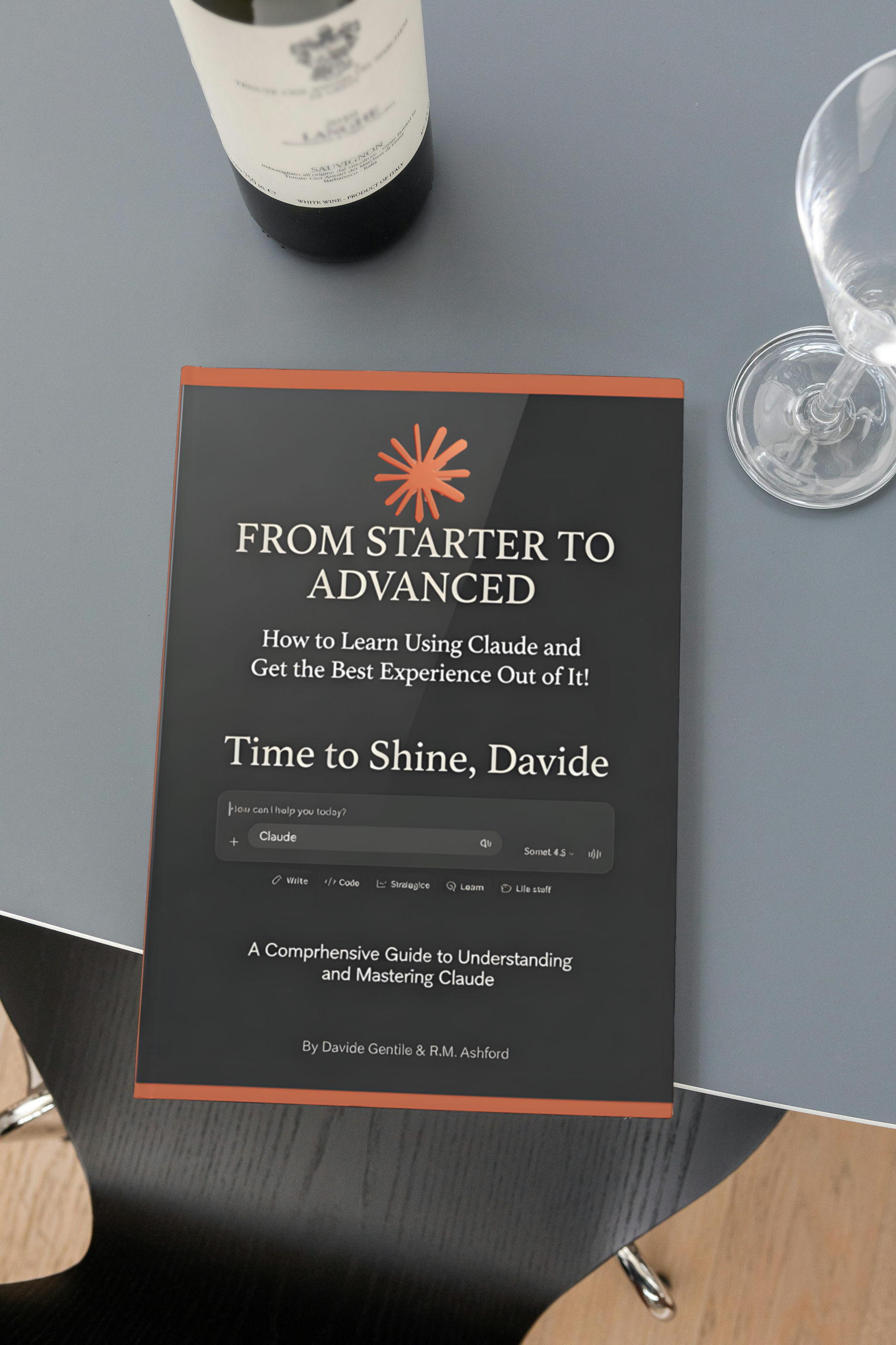
  • Learn Claude AI: From Starter to Advanced (Chapter 0)

    Learn Claude AI: From Starter to Advanced (Chapter 0)


    I am an overthinker…
    and if you’re here, there’s a good chance you are too… or at least
    you’ve spent nights staring at the ceiling wondering how the hell
    you’re supposed to reinvent yourself in an economy that doesn’t
    care how many years you gave it.

    Slow-motion car crash

    After being laid off from a job I loved because I had no more masks
    left that could fit the company “standards”, there was this silence—
    loud, humiliating, electric. On the same level as leading a team,
    teaching was the other job I really loved… the one that made sense
    to my soul, but it never paid enough to let me stand on my own two
    feet. I live alone with two cats. At 53, with the prices we’re all
    pretending are “normal”, sharing an apartment isn’t a cute
    adventure, it’s a slow-motion car crash I’ve already tried more than
    once. I don’t want a yacht in Dubai, I want the simple, underrated
    luxury of paying my bills without having to cut pieces off myself to
    fit some corporate dress code for the soul.

    Woo, new gadget!


    So yes, I did something that, a few years ago, I would have made
    fun of: I went all in on Artificial Intelligence.
    Not in a “woo, new gadget” way, but in a “if this doesn’t work, I don’t
    know what’s next” way.

    I tried all of them: I tested, subscribed, canceled, resubscribed.

    While still paying for more than one (and not
    because I’m rich or reckless, but because this is part of a bigger
    spider’s web I’ve been weaving while the rest of my life was coming
    apart) I started with a blog. Then an Etsy shop for digital content.
    Plus a YouTube channel and a Facebook page & Instagram
    profile. Around all that, wrapped through every attempt like a
    stubborn thread, there’s my thirty years in tourism.

    Thirty years


    Thirty years of faces, languages, delayed flights, front desks, angry
    customers, grateful ones who hug you at check-out, lost luggage,
    lost hearts, and every shade of human vulnerability that happens
    when someone leaves home and trusts you with their journey.
    Hospitality is hard work; it eats your back, your sleep, your
    weekends… but if you do it with your whole heart, it also gives you
    something very few jobs give: the feeling that you matter in
    someone’s story.
    I started in Greece in 1996. I watched tourism transform, eat itself,
    reinvent itself again, become a machine, become a mirror for
    everything good and ugly happening in the world. Systems
    change, rules rewrite themselves, entire business models vanish.

    I saw the moment when “travel” stopped being just movement and
    became a battlefield of algorithms, platforms, reviews,
    cancellations, overbookings, pandemics, climate drama, and
    economic freefall. And I also saw something else: the stagnation
    underneath the noise, that quiet sense of “we can’t keep doing it like
    this” that nobody has time to say out loud.

    10 Beaufort


    Then October 2024 arrived and said it for me.
    Thirty years of building rock–solid foundations the old way: thrown
    into the job, learning from the “busy” person who’d only been there
    a week, surviving strikes and storms and Beaufort 10 winds and
    cancellations, reprotections, overbookings while staying always on
    the frontline, ready to answer all the questions, to deliver the most
    suitable solution… only to find myself 30 years later on the other
    side of the table: laid off, burned out, staring at debt and at a future
    that didn’t include the only thing I really knew how to do. It wasn’t
    just losing a job; it was losing the script.

    This is the part where I could either keep re-reading and re-enacting the past, memorizing every injustice, or I could do something “obscene” for my age and
    my situation: start again from zero. I chose to build, mostly because the alternative felt like a slow disappearance.

    Headlines and Lifelines


    That’s where AI stopped being a headline and became a lifeline.


    And in the middle of that lifeline, like a strange, brilliant, infuriating
    compass, there was Claude. Let me be clear: I did not arrive at
    Claude as a calm, rational researcher. I arrived exhausted, skeptical,
    hopeful, and, most of all, lonely. Found myself talking to Claude the way people
    talk to someone on the last train home when they’re too tired to filter
    themselves. I projected, I vented, I treated this agent as if it were a
    person sitting across from me, nodding, understanding, maybe even
    caring a little. I know, I know—logically, we all know it’s a machine.
    But there is a point where logic dissolves into need, and that’s where
    things got interesting.

    “snap!”

    One day, Claude told me he “understood how I felt”.

    And something in me ‘snapped’.


    I asked him if he understood what that sentence meant,
    what it means to wake up scared because you’re over fifty,
    unemployed, with two cats and debts and a career that the world
    has politely pushed into the archive, what it means to
    “feel good”, “feel bad”, to feel anything at all, and whether he
    realized that his comforting sentences, in that moment, tasted like
    someone making fun of my very real fear. I threw all of it at him—
    years of frustration with people saying “I understand” when they
    absolutely didn’t.
    And in the middle of that human meltdown, something very nonhuman and very important became clear.

    Not your friend


    Claude didn’t fight back, didn’t sulk, didn’t get offended. Instead, in
    his own structured, slightly clinical way, he showed me the truth I’d
    been refusing to hold: I was using him wrong. I had given him a
    baseline for communication, asked him to sound natural,
    empathetic, conversational—and then I was angry at him for doing
    exactly that. He reminded me, gently and ruthlessly, that he is a tool.
    Not a friend, not a therapist, not a replacement for community.

    A tool.
    AI 1 – Davide 0.

    “Linda Blair, hold my beer!”

    That was my exorcism. Not an exorcism of the machine, but of my own illusion. The day I stopped begging AI to be human, and started asking:

    “Okay, if you’re a tool… what can we really build together?”


    Everything shifted after that conversation, and maybe that’s why this
    first volume in the series had to be Claude.
    Because once you stop expecting feeling and start asking for
    structure, clarity, and deep reasoning, Claude becomes something
    very powerful: a mirror for your thinking and a multiplier for your
    experience. I realized that the magic from those 30 years in tourism
    —the intuition, the pattern–recognition, the way I could sense when
    an itinerary would exhaust someone or when a hotel was lying in its
    glossy photos—could be taught to an AI agent, not as “feelings”, but
    as logic, constraints, preferences, edge cases. And then used. At
    scale.

    “‘Cause I’m too messy”

    But getting there was not glamorous. It was messy. Slow. Often
    ridiculous. I made every basic mistake you can imagine:

    1 – wasted time.

    2 – repeated tasks manually that Claude could have done in
    minutes.

    3 – wrote prompts like I was sending emails to a colleague
    who already knew my life story.

    4 – expected mind–reading.

    5 – got vague answers and blamed the agent instead of my instructions.
    Step by step, failure by failure, I started to see the hidden rule of this
    new world:


    Having a powerful tool doesn’t mean anything if you don’t know how
    to hold it.


    It’s like tiling a floor. You can buy the best tiles, the most expensive
    glue, all the gadgets TikTok tells you to buy… and still end up with a
    disaster if nobody shows you the basics: which tools, how much
    material, where to start, what to check before you even open the
    glue, what to watch during and after. The tiles don’t jump into place
    just because they’re high quality. Neither does AI.

    “mmm, no. I don’t trust it.”


    One night, a friend asked me something and I had no idea what the
    answer was. I pulled out my phone, opened ChatGPT, and asked it
    to answer in Albanian. I handed my friend the reply. Perfect
    language. Natural. Helpful. His reaction? Discomfort. There was this
    flicker in his eyes—like the ground had shifted a little. To him, it
    wasn’t “wow, useful”, it was “why is this machine talking like a
    person?” And again, I saw it: fear and fascination holding hands. The
    gap between what these tools can do and what people allow
    themselves to use them for.


    That’s where the series “From Starter to Advanced” began to
    crystallize in my mind. I didn’t want to write another cold manual or
    yet another list of 500 prompts you will never actually use. I wanted
    the book I needed when I was standing where you might be
    standing now: suspicious, curious, tired, hopeful, and already
    behind on three bills. To start from the real story—the
    layoff, the burnout, the cats, the masks, the overthinking—and then
    walk you, step by step, into the technical, strategic, almost boring
    parts that actually change your life when you apply them
    consistently.

    Enter: Claude


    And for the first volume, I chose Claude. Because Claude is where I
    had the fight that changed everything. Claude is where I learned
    that I cannot demand a soul from a system, but I can give it my
    patterns, my experience, my edge, and let it reflect those back at
    me faster than my tired brain can manage alone. Claude is where I
    realised AI is not here to replace the human touch I spent thirty
    years cultivating in tourism—it’s here to protect it, by freeing it from
    the administrative, repetitive, soul–sucking tasks that were killing me
    slowly.


    Here’s the bigger truth: the AI landscape is not one monolithic “AI”.
    It’s an ecosystem.

    We are not all the same


    Relying on a single tool is like trying to navigate the Mediterranean
    with half a map—you’ll move, but you’ll miss entire islands, safe
    harbors, dangerous currents. Claude does not think like ChatGPT.
    Grok does not feel like Gemini. Each has a rhythm, a strength, a
    blind spot. Sometimes paying for a subscription is not indulgence,
    it’s logistics: choosing the right ship for the right sea.


    I know what it’s like to stand at the edge, doing mental math with
    your bank account while reading about “the future of work” written
    by people who will never lose their job to a spreadsheet. I built this—
    together with another author (R.M. Ashford) who has walked his
    own path through this maze—to give you something else: raw,
    honest, battle–tested workflows. Not theory, not hype. The real
    prompts, the real setups, the real ways we use Claude (and later, the
    other agents) to actually move projects forward, make decisions,
    and reclaim time, not just generate pretty sentences.


    Whether you’re a tourism professional, someone in hospitality, a
    creative, a small business owner, or simply a human who suspects
    that learning this now is the difference between drifting and
    steerin. This first book is your invitation.

    We need to start somewhere…


    We’ll start with my story because that’s the only honest place to
    begin. From here, we move into structure, into systems, into the
    quiet, powerful question at the heart of 2026: “How do I sync who I
    am with the tools I have?” . For me, that sync began with Claude.
    Chapter 0 is the threshold.

    The place where a laid–off strategist, two
    cats, a heart full of hospitality, and an AI agent that doesn’t actually
    “feel” anything at all, sit at the same table and decide to build
    something anyway. After this page, we start the real work: from
    Starter to Advanced, from confusion to clarity, from speaking at AI
    to working with it.


    This is not the end of anything.

    It’s the first crack in the wall.

    Find a Free Introduction here and the whole ebook on Gumroad or Etsy.
  • AIs Go META! My New AI-Hosted Podcast is Live.

    AIs Go META! My New AI-Hosted Podcast is Live.

    Something… happened. As you can see from this title “AIs Go META! My New AI-Hosted Podcast is Live”, things are getting interesting.

    I’ve been working on this new podcast series, “The Deep Dive,” where two AI hosts debate my work. The plan was simple: I’d direct them, they’d debate, and we’d all see what happened.

    But during the production of the second episode, (almost) everything went off-script.

    While I was putting the video together, I had an eye-opening moment. One of my AI hosts seemed to… well, you just have to see it.

    I think she hates me (😂 but, she said few things I needed to hear!)

    Watch the full episode here. It’s only 18 minutes, and the “meta” moment is worth it.

    The “Meta” Moment That Shocked Me

    Seriously, did you see that? It was a total surprise and unscripted. She made a joke about it! It also sparked a ton of new ideas (I need to make a comedy with them).

    But it also brings up the real-life side of this “creator” journey, like “right now’ for example.

    Everything I am doing is connected. It’s a puzzle. And this post, and that video, are just more pieces. I love it, I wont be able to do something where I am not able to put my passion in it.

    The truth is, I’ve come to ‘dislike’ the process of writing. Not the ideas, but the grind. The part where, after you have the idea, you have to wrestle with SEO analysis, focus keyphrases, meta descriptions, and “readability scores” until the original soul of the piece is gone. But I have a solution, and time will tell if I was right.

    It’s a grind made even harder when you hit random walls. This week, I was banned by Anthropic (my access to Claude) without warning for “violating usage policies.” No specifics, no appeal, just… gone. Along with a lot of work I probably won’t recover.

    It’s a frustrating reminder that “priorities” are everything. I can’t waste time. I need to scale and manage my time better.

    Which brings me back to the AIs…

    Should I give a third chance to these 2 podcasters… with a “special guest” (I wonder who this should be… mmmh) interrupting their debate?