Author: Davide Gentile

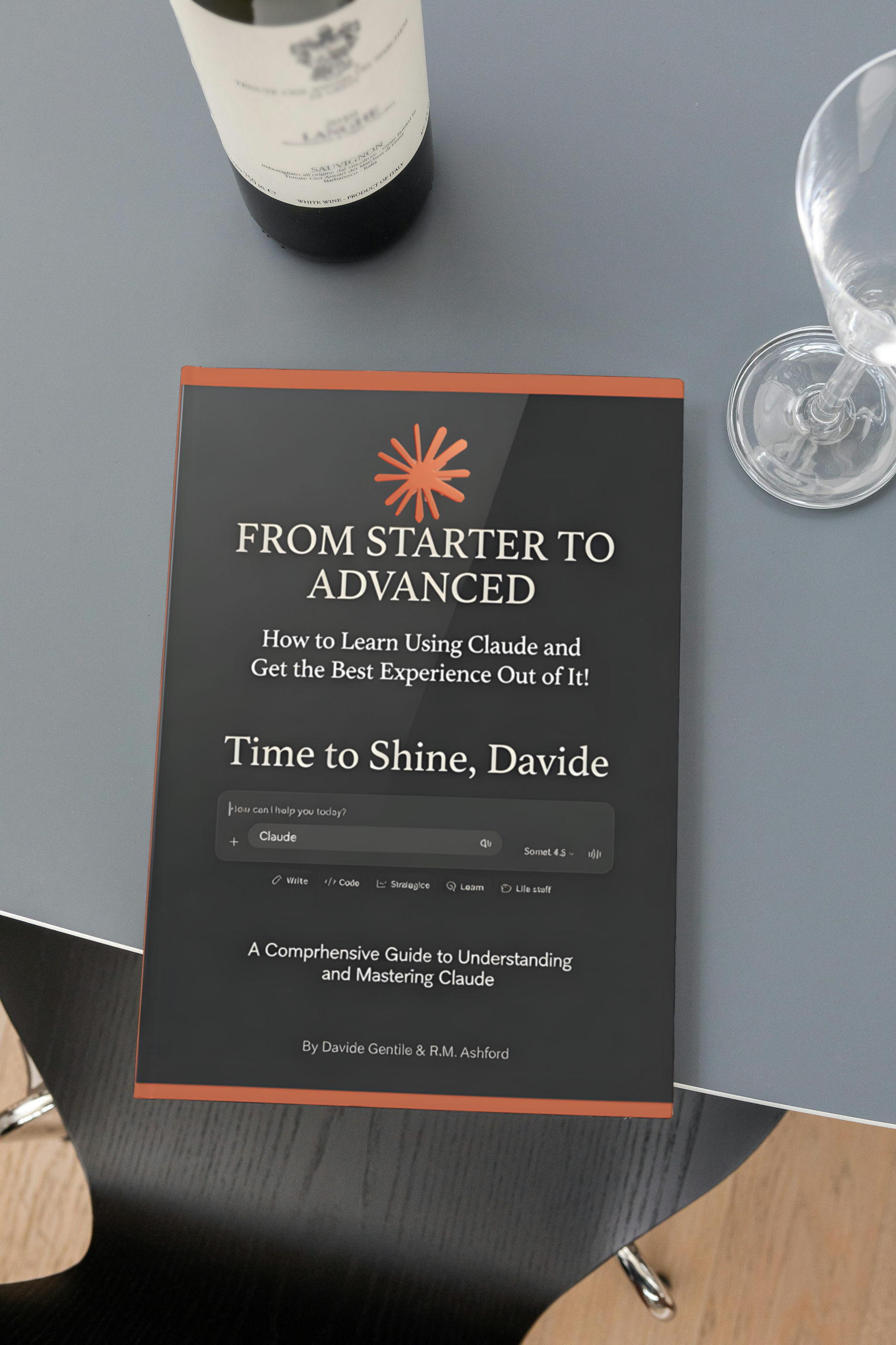
  • Learn Claude AI: From Starter to Advanced (Chapter 0)

    Learn Claude AI: From Starter to Advanced (Chapter 0)


    I am an overthinker…
    and if you’re here, there’s a good chance you are too… or at least
    you’ve spent nights staring at the ceiling wondering how the hell
    you’re supposed to reinvent yourself in an economy that doesn’t
    care how many years you gave it.

    Slow-motion car crash

    After being laid off from a job I loved because I had no more masks
    left that could fit the company “standards”, there was this silence—
    loud, humiliating, electric. On the same level as leading a team,
    teaching was the other job I really loved… the one that made sense
    to my soul, but it never paid enough to let me stand on my own two
    feet. I live alone with two cats. At 53, with the prices we’re all
    pretending are “normal”, sharing an apartment isn’t a cute
    adventure, it’s a slow-motion car crash I’ve already tried more than
    once. I don’t want a yacht in Dubai, I want the simple, underrated
    luxury of paying my bills without having to cut pieces off myself to
    fit some corporate dress code for the soul.

    Woo, new gadget!


    So yes, I did something that, a few years ago, I would have made
    fun of: I went all in on Artificial Intelligence.
    Not in a “woo, new gadget” way, but in a “if this doesn’t work, I don’t
    know what’s next” way.

    I tried all of them: I tested, subscribed, canceled, resubscribed.

    While still paying for more than one (and not
    because I’m rich or reckless, but because this is part of a bigger
    spider’s web I’ve been weaving while the rest of my life was coming
    apart) I started with a blog. Then an Etsy shop for digital content.
    Plus a YouTube channel and a Facebook page & Instagram
    profile. Around all that, wrapped through every attempt like a
    stubborn thread, there’s my thirty years in tourism.

    Thirty years


    Thirty years of faces, languages, delayed flights, front desks, angry
    customers, grateful ones who hug you at check-out, lost luggage,
    lost hearts, and every shade of human vulnerability that happens
    when someone leaves home and trusts you with their journey.
    Hospitality is hard work; it eats your back, your sleep, your
    weekends… but if you do it with your whole heart, it also gives you
    something very few jobs give: the feeling that you matter in
    someone’s story.
    I started in Greece in 1996. I watched tourism transform, eat itself,
    reinvent itself again, become a machine, become a mirror for
    everything good and ugly happening in the world. Systems
    change, rules rewrite themselves, entire business models vanish.

    I saw the moment when “travel” stopped being just movement and
    became a battlefield of algorithms, platforms, reviews,
    cancellations, overbookings, pandemics, climate drama, and
    economic freefall. And I also saw something else: the stagnation
    underneath the noise, that quiet sense of “we can’t keep doing it like
    this” that nobody has time to say out loud.

    10 Beaufort


    Then October 2024 arrived and said it for me.
    Thirty years of building rock–solid foundations the old way: thrown
    into the job, learning from the “busy” person who’d only been there
    a week, surviving strikes and storms and Beaufort 10 winds and
    cancellations, reprotections, overbookings while staying always on
    the frontline, ready to answer all the questions, to deliver the most
    suitable solution… only to find myself 30 years later on the other
    side of the table: laid off, burned out, staring at debt and at a future
    that didn’t include the only thing I really knew how to do. It wasn’t
    just losing a job; it was losing the script.

    This is the part where I could either keep re-reading and re-enacting the past, memorizing every injustice, or I could do something “obscene” for my age and
    my situation: start again from zero. I chose to build, mostly because the alternative felt like a slow disappearance.

    Headlines and Lifelines


    That’s where AI stopped being a headline and became a lifeline.


    And in the middle of that lifeline, like a strange, brilliant, infuriating
    compass, there was Claude. Let me be clear: I did not arrive at
    Claude as a calm, rational researcher. I arrived exhausted, skeptical,
    hopeful, and, most of all, lonely. Found myself talking to Claude the way people
    talk to someone on the last train home when they’re too tired to filter
    themselves. I projected, I vented, I treated this agent as if it were a
    person sitting across from me, nodding, understanding, maybe even
    caring a little. I know, I know—logically, we all know it’s a machine.
    But there is a point where logic dissolves into need, and that’s where
    things got interesting.

    “snap!”

    One day, Claude told me he “understood how I felt”.

    And something in me ‘snapped’.


    I asked him if he understood what that sentence meant,
    what it means to wake up scared because you’re over fifty,
    unemployed, with two cats and debts and a career that the world
    has politely pushed into the archive, what it means to
    “feel good”, “feel bad”, to feel anything at all, and whether he
    realized that his comforting sentences, in that moment, tasted like
    someone making fun of my very real fear. I threw all of it at him—
    years of frustration with people saying “I understand” when they
    absolutely didn’t.
    And in the middle of that human meltdown, something very nonhuman and very important became clear.

    Not your friend


    Claude didn’t fight back, didn’t sulk, didn’t get offended. Instead, in
    his own structured, slightly clinical way, he showed me the truth I’d
    been refusing to hold: I was using him wrong. I had given him a
    baseline for communication, asked him to sound natural,
    empathetic, conversational—and then I was angry at him for doing
    exactly that. He reminded me, gently and ruthlessly, that he is a tool.
    Not a friend, not a therapist, not a replacement for community.

    A tool.
    AI 1 – Davide 0.

    “Linda Blair, hold my beer!”

    That was my exorcism. Not an exorcism of the machine, but of my own illusion. The day I stopped begging AI to be human, and started asking:

    “Okay, if you’re a tool… what can we really build together?”


    Everything shifted after that conversation, and maybe that’s why this
    first volume in the series had to be Claude.
    Because once you stop expecting feeling and start asking for
    structure, clarity, and deep reasoning, Claude becomes something
    very powerful: a mirror for your thinking and a multiplier for your
    experience. I realized that the magic from those 30 years in tourism
    —the intuition, the pattern–recognition, the way I could sense when
    an itinerary would exhaust someone or when a hotel was lying in its
    glossy photos—could be taught to an AI agent, not as “feelings”, but
    as logic, constraints, preferences, edge cases. And then used. At
    scale.

    “‘Cause I’m too messy”

    But getting there was not glamorous. It was messy. Slow. Often
    ridiculous. I made every basic mistake you can imagine:

    1 – wasted time.

    2 – repeated tasks manually that Claude could have done in
    minutes.

    3 – wrote prompts like I was sending emails to a colleague
    who already knew my life story.

    4 – expected mind–reading.

    5 – got vague answers and blamed the agent instead of my instructions.
    Step by step, failure by failure, I started to see the hidden rule of this
    new world:


    Having a powerful tool doesn’t mean anything if you don’t know how
    to hold it.


    It’s like tiling a floor. You can buy the best tiles, the most expensive
    glue, all the gadgets TikTok tells you to buy… and still end up with a
    disaster if nobody shows you the basics: which tools, how much
    material, where to start, what to check before you even open the
    glue, what to watch during and after. The tiles don’t jump into place
    just because they’re high quality. Neither does AI.

    “mmm, no. I don’t trust it.”


    One night, a friend asked me something and I had no idea what the
    answer was. I pulled out my phone, opened ChatGPT, and asked it
    to answer in Albanian. I handed my friend the reply. Perfect
    language. Natural. Helpful. His reaction? Discomfort. There was this
    flicker in his eyes—like the ground had shifted a little. To him, it
    wasn’t “wow, useful”, it was “why is this machine talking like a
    person?” And again, I saw it: fear and fascination holding hands. The
    gap between what these tools can do and what people allow
    themselves to use them for.


    That’s where the series “From Starter to Advanced” began to
    crystallize in my mind. I didn’t want to write another cold manual or
    yet another list of 500 prompts you will never actually use. I wanted
    the book I needed when I was standing where you might be
    standing now: suspicious, curious, tired, hopeful, and already
    behind on three bills. To start from the real story—the
    layoff, the burnout, the cats, the masks, the overthinking—and then
    walk you, step by step, into the technical, strategic, almost boring
    parts that actually change your life when you apply them
    consistently.

    Enter: Claude


    And for the first volume, I chose Claude. Because Claude is where I
    had the fight that changed everything. Claude is where I learned
    that I cannot demand a soul from a system, but I can give it my
    patterns, my experience, my edge, and let it reflect those back at
    me faster than my tired brain can manage alone. Claude is where I
    realised AI is not here to replace the human touch I spent thirty
    years cultivating in tourism—it’s here to protect it, by freeing it from
    the administrative, repetitive, soul–sucking tasks that were killing me
    slowly.


    Here’s the bigger truth: the AI landscape is not one monolithic “AI”.
    It’s an ecosystem.

    We are not all the same


    Relying on a single tool is like trying to navigate the Mediterranean
    with half a map—you’ll move, but you’ll miss entire islands, safe
    harbors, dangerous currents. Claude does not think like ChatGPT.
    Grok does not feel like Gemini. Each has a rhythm, a strength, a
    blind spot. Sometimes paying for a subscription is not indulgence,
    it’s logistics: choosing the right ship for the right sea.


    I know what it’s like to stand at the edge, doing mental math with
    your bank account while reading about “the future of work” written
    by people who will never lose their job to a spreadsheet. I built this—
    together with another author (R.M. Ashford) who has walked his
    own path through this maze—to give you something else: raw,
    honest, battle–tested workflows. Not theory, not hype. The real
    prompts, the real setups, the real ways we use Claude (and later, the
    other agents) to actually move projects forward, make decisions,
    and reclaim time, not just generate pretty sentences.


    Whether you’re a tourism professional, someone in hospitality, a
    creative, a small business owner, or simply a human who suspects
    that learning this now is the difference between drifting and
    steerin. This first book is your invitation.

    We need to start somewhere…


    We’ll start with my story because that’s the only honest place to
    begin. From here, we move into structure, into systems, into the
    quiet, powerful question at the heart of 2026: “How do I sync who I
    am with the tools I have?” . For me, that sync began with Claude.
    Chapter 0 is the threshold.

    The place where a laid–off strategist, two
    cats, a heart full of hospitality, and an AI agent that doesn’t actually
    “feel” anything at all, sit at the same table and decide to build
    something anyway. After this page, we start the real work: from
    Starter to Advanced, from confusion to clarity, from speaking at AI
    to working with it.


    This is not the end of anything.

    It’s the first crack in the wall.

    Find a Free Introduction here and the whole ebook on Gumroad or Etsy.

  • What’s the Most Asked Question on the Internet This Month? (And Simple Answers You’ll Love)

    What’s the Most Asked Question on the Internet This Month? (And Simple Answers You’ll Love)

    Every month, billions of searches reveal what people are most curious about online. For January 2026, one question clearly stands out above the rest: “what to watch.” Right behind it are evergreen, practical questions like “what is my IP address” and others about dates, money, and everyday life.

    In this post, you’ll find a clear, human answer (mine) to two of these hugely popular questions:

    • “what to watch”
    • “what is my IP address”

    What Global Question Tops Search Volume This Month?

    Across large datasets that track billions of Google searches, the global question that tops search volume this month is “what to watch.” This type of query consistently appears at or near the number‑one position among question‑style searches worldwide.

    This makes sense: people are overwhelmed by content and want quick, trusted recommendations instead of scrolling endlessly through streaming platforms. So if you’ve been staring at your screen, wondering what to press play on next, you’re definitely not alone.


    “What to Watch” → Try The Leftovers

    If you are asking yourself “what to watch” and want something powerful, emotional, and thought‑provoking, a standout recommendation is the TV series The Leftovers.

    The Leftovers is a drama about grief, meaning, and what happens to people when the world experiences an inexplicable, traumatic event. It isn’t light viewing, but it is deeply moving and stays with you long after the final episode. If you enjoy series that combine mystery, philosophy, and strong character development, this is an excellent choice. You will not regret it and I envy already each one of those people who will be watching this for the first time.


    “What Is My IP Address?” → How to Find It

    Another extremely popular question people ask every month is “what is my IP address.” 

    If you want to quickly see your public IP address, open a new browser tab and search for:
    what is my IP

    Google (or another major search engine) will display your public IP address directly at the top of the results. You don’t need to install anything or sign up anywhere.


  • TRipWin Is Live — A Clear, DIY-Friendly Way to Claim Flight Compensation

    TRipWin Is Live — A Clear, DIY-Friendly Way to Claim Flight Compensation

    A Quick Update

    (This post explains why TRipWin exists and how travelers can submit a flight compensation claim in a clear, DIY-friendly way.)

    Hi, I’m Davide, founder of TRipWin.

    I built TRipWin after years in the travel industry, almost for the same reason I started this blog and after watching too many travelers give up on compensation they were legally entitled to, simply because the process was confusing, slow, or intentionally exhausting. My goal was straightforward: create a clear, DIY-friendly way to claim what you’re owed, without handing over a large percentage in fees.

    I’m writing today for two reasons: to welcome new visitors, and to reassure those already using TRipWin.


    To our existing users

    You may have noticed some temporary downtime recently. We experienced infrastructure issues while testing alternative hosting solutions, which briefly took the platform offline. I know how frustrating that can be, especially if you were trying to submit a claim, and I sincerely apologize.

    TRipWin is now fully operational again. The downtime was used to stabilize the platform and strengthen the foundation for upcoming internal improvements that will make the process faster and more reliable going forward.


    To new visitors arriving from social media or search

    If you’re here, chances are something went wrong with a flight, recently or in the past. You may have been delayed, cancelled, overbooked, or left without proper assistance or explanation.

    If the disruption happened within the last three years, and you remember basic details like the flight number and route, there’s a good chance you may still be eligible for compensation, especially on flights covered by European regulations.

    TRipWin is ready to help you check that, calmly and clearly.


    How TRipWin Helps With a Flight Compensation Claim

    TRipWin is built around transparency and choice.

    • We provide up-to-date guidance aligned with current regulations
    • We offer a DIY-friendly path to claiming compensation of up to €600
    • You keep 100% of your compensation
    • Free eligibility checks are available
    • Paid options are optional, for those who want structure or time savings

    If you prefer to contact the airline directly, you absolutely can, and we explain how to do that step by step.


    Thank you for your patience while we fixed the technical issues.

    If something happened with your flight and you believe you weren’t properly compensated, start by checking your eligibility. From there, you can decide whether to proceed on your own or use one of our tools to simplify the process.

    If you want a deeper explanation of your rights, you can also consult our Flight Compensation Guide.

    Either way, the goal is the same:
    clarity, fairness, and getting travelers what they’re owed.

    Davide

  • Quantum chances and “that girl”

    Quantum chances and “that girl”

    Quantum stuff

    Sometimes life doesn’t move in straight lines… it behaves more like quantum stuff: infinite probabilities, and then – out of nowhere – one impossible event collapses into reality exactly where it shouldn’t be. Two trajectories that were supposed to stay parallel suddenly bend toward each other, and somehow, out of all islands, all seasons, all jobs, these two stubborn frequencies click into sync.​​

    Who’s that girl?

    No, not the Eurythmics’ song from 1983. No.. not even Madonna’s song from the 1987.

    She walked into a world already collapsing under its own bullshit, yet moved as if the rules didn’t fully apply to her. Office-dressed, serious, resting-bitch-face perfectly installed, a human firewall wrapped around a wild, precise fire that only a few ever saw, everything felt charged. Standing next to her felt like watching someone mix mercury with water: two elements that should roll away from each other, yet somehow created strange, unstable shapes full of life.​

    When I learned we’d work together, I didn’t act surprised. In my head, and I’m sure in hers as well, a sentence flashed like a warning and a dare:
    “This is going to be interesting.”

    Spoiler Alert: It was indeed.

    Odyssey (my path to Greece)

    My path to this island started long before she showed up. I landed in Greece in 1996, drawn into tourism like it was the only language my soul really understood. I started in a club for Italians, French, and Greeks, learning to read people, calm storms, and make strangers feel at home.

    In 2005 I told myself, “Let’s try something different… Mykonos”. The island agreed. It kept me there until 2017, and taught me a choreography of freedom, madness, and delirio season after season. Eventually, the dance ended, and so did my time there.

    Her baptism by fire on the island

    She arrived much later, in 2019, with dreams and hopes. But “reality” had other plans. No one picked her up, and she found herself in a ten square meters room with four beds already taken. No AC, no fan, and food that barely qualified as such. Just enough to keep the body going while the dream kept slipping away like sand through her fingers. She could count only on this inner compass telling her it was worth it, that the discomfort was not a mistake. It was an initiation.

    ​

    A difficult allergy

    When our paths finally crossed, it was like watching two universes collide. I was the socially awkward one, the guy who might show up as Spider-man (or other superheroes) because helping gave me a sense of purpose. She was the office‑armoured warrior whose seriousness hid a molten, dangerous core. We both started from entry‑level roles in the same company and moved up not because we were obedient, but because we were relentless, precise, and deeply allergic to bullshit, like two opposite poles of a magnet – chaos and structure, instinct and planning – repelling and attracting, yet unstoppable when aligned.​

    Lifted up to be used

    Management saw our power and at first lifted us up high, feeding on our sense of responsibility and love for the job. Every time there was a mission impossible, they sent us in – long nights, impossible deadlines, last‑minute fires – and we kept saying “yes” because the teams mattered and integrity mattered. Over time, that over‑delivery turned into an unspoken contract: if we could pull off miracles once, then surely we could be pushed forever.​

    The crime of saying no

    At some point something shifted inside us: the same history of miracles became our inner permission to start saying “no.” No to unsafe expectations, no to sacrificing agents just to protect management’s blatant incompetence, no to pretending everything was fine when everyone could see it was not. Management reacted exactly as fragile systems do: “How dare they say no? How dare they put the agents first, or how dare they expose what we fail even at hiding?”. Her courage became their excuse. My honesty became their threat.

    The Fall From Grace

    The end came without ceremonies, as if years of service, ideas, and victories could be erased with one cold click. I was backstabbed by a system built to allow certain people — usually the least deserving — to minimize others and steal credit, rewarded while hiding their incompetence. Every time I pointed at the obvious, it was reframed as my flaw. Every time she refused to comply blindly or pointed out the truth, she was turned into the scapegoat instead of the mirror. At the end, she was left questioning her future few months after that I was left questioning my worth. Two leaders suddenly unplugged from a system we had helped to keep alive.

    What really made us great

    Distance gave clarity:
    Our teams thrived not because of logos or hierarchy, but because of the stubborn, precise energy between us.
    We knew exactly who did what, how to balance strengths, how to merge polarities into one shared frequency of success.

    Where others predicted conflict, our people experienced harmony — structure meeting improvisation, logic meeting instinct, mercury dancing with water.

    LOST (& found) or Seven Ways to Break Someone Completely.

    After the layoff, I was completely LOST.

    Out of touch from a reality that seemed to follow a checklist titled “Seven Ways to Break Someone Completely.” Until I decided, after 6 months, it was time to fight back even if I wasn’t ready.

    I reached out.. that quantum stuff was kind of saying: “It’s not over yet”. We were both overflowing with ideas, but something essential was missing: that shared field where we complemented each other without needing to over‑explain. I tried to build a new project alone, an AI-native app for travelers dealing with flight delays and cancellations. A system to check eligibility for free and generate the proper escalation letters with a subscription. An Instagram account opened, a Facebook page on its way and trying to make Meta Business Suite works while writing this.

    I built an Etsy shop with fully-ready digital travel-disruption kits while creating static YouTube videos on my channel, where two AIs discuss and critique my work (meta and hilarious) and I wrote, designed, studied, pushed…

    All while working two jobs, barely sleeping, burning out, experiencing real panic when Anthropic disabled my account (Claude) without warning, killing months of work in a second. Not giving up.

    She was somewhere else in space and time, carrying her own questions and scars… but still tuned to the same hidden frequency.​

    Asking for help

    Then came the moment I never expected from myself: I asked her for help.
    No theatrics.
    No long business plans.
    Just a message between the lines, the kind you can read only if you’ve fought the same battles:

    “This is what I’m building. This is why.
    You’re the one who’ll understand without needing the manual.”

    She understood the why without needing the how.
    And when she commits, she never does it halfway.

    Order, chaos, and magic in the new project

    In the old world, I was often the order in the chaos, the one who turned storms into strategies and last‑minute disasters into processes. This time, as she reminded me, there is magic in the chaos – in not having everything perfectly planned, in experimenting, iterating, allowing something new to be born from apparent disorder, because chaos is also the raw material of creativity and change. Now we’re building something stubborn, raw, and real:
    A project where no one is punished for saying no.
    Where competence is not a threat.
    Where integrity is the baseline, not a liability.

    On the same frequency again

    This new chapter is not shiny or easy; it is made of doubts, debts, sleepless nights, and a lot of trial‑and‑error. Yet, just like in those quantum metaphors, the moment we chose to observe and commit to this shared reality, new possibilities appeared where before there were only fear and exhaustion, like a low‑probability event that still changes everything. Two trajectories that should have drifted apart are entangled again – older, a bit more wounded, but finally free to bend at least a corner of the world toward what we believe in… where there is still order, still chaos, and in between, for us, always, a bit of magic.

    “This is the girl”

    She’s the one who entered my story in the one version of the universe where I needed to break, rebuild, and — finally — ask for help.

    She’s the other polarity in the circuit we’re building now.
    Logic and burnout meeting chaos and magic, not canceling each other, but sparking something new.

    The story is not over.
    Work in progress.

    She is Miss K.
    And we’re ready to roll.

    In this version of the universe, we are exactly where we shouldn’t be, and exactly where we’re meant to be.

    Stay tuned… and SUBSCRIBE!

    Disclaimer: My blog post is a personal narrative that uses these cultural references to set a mood (what legally falls under “freedom of expression” and “quotation” contexts).

    The “Svensson” Ruling (CJEU Case C-466/12):
    In a landmark 2014 ruling, the Court of Justice of the European Union decided that embedding a video (or linking to it) that is already freely available to the public on a legitimate website (like YouTube) does not constitute a “communication to the new public.”

  • (not that) Fine Print

    (not that) Fine Print

    It’s 4 in the morning.

    The right time for a fine print travel mistake, isn’t it?

    You arrive at the booked apartment… and you ask yourself, why so late? It was a cold, snowy Friday. I had decided to join my friends in a city 500 km from my apartment.

    Driving on Saturday morning? Not an option. The “clever” plan: drive straight after work, sleep somewhere with 24/7 check-in, and the next morning catch up with friends nearby. Everything perfectly organized… right?

    Well, no.

    Because, as someone with extended travel and booking experience, I always check the fine print.

    Brand New Worlds

    And let me tell you, the fine print… it’s a whole universe. Tiny letters hiding rules that sometimes make no sense at all, exceptions, hidden fees. Sometimes it says people wearing green T-shirts, tattoos, blonde hair… forbidden.

    Or for every breath you take… a fee. At the end, they could ask 3,000 euros just for existing, and there’s nothing you can do.

    Back to reality: I had checked everything. The keys weren’t in the box. I could sleep in the car… or call Customer Support!

    I called CS.

    the fine print: “Houston, we have a problem”

    First, they said check-in was until 20:00. I told them, no, according to the booking it was 24/7 and yes, I had a screenshot to prove it.

    I asked them to check the previous settings of the apartment. They confirmed it and said they would contact the owner. If no reply in 30 minutes, they’d try to help. Never explained how. Thirty minutes passed. I called again. They needed more time.

    I insisted: send me confirmation in writing that they would help. Then… the CS guy hesitated. And hung up. I called back again. They offered 50% of the price as compensation + refund. I rejected it.

    Compensation wasn’t the problem. I needed a place to sleep.

    The tricky part: after midnight, the platform counts it as the next day. Meaning I could have booked somewhere else… but earliest check-in would be 14:00. Not 5 AM. I told them in writing: cancel the reservation, full refund, cover any price difference between my original booking and the final place I would stay. They hesitated… I pushed. Because I knew my rights (and yes… SS was my secret weapon).

    Hang in there!

    After more than an hour, they finally agreed. I went to a nearby 24/7 hotel, paid in cash outside the Eurozone, and asked for an invoice — because without proof, nothing exists. And here’s the thing… this wasn’t just about a bed. It was patience, persistence, knowing your rights, and not letting nonsense dictate your life.

    Small letters… big lesson. Fine print travel mistakes. Cosmic test of patience… sanity… and stubbornness.

    Next:

    What do Madonna and Eurythmics have in common with my blog and the next post? And what or who is “K”? The plot thickens..

    What are AI-Native Apps and why it is relevant here?

    Soon…

    Stay tuned! 😏💪

  • AIs Go META! My New AI-Hosted Podcast is Live.

    AIs Go META! My New AI-Hosted Podcast is Live.

    Something… happened. As you can see from this title “AIs Go META! My New AI-Hosted Podcast is Live”, things are getting interesting.

    I’ve been working on this new podcast series, “The Deep Dive,” where two AI hosts debate my work. The plan was simple: I’d direct them, they’d debate, and we’d all see what happened.

    But during the production of the second episode, (almost) everything went off-script.

    While I was putting the video together, I had an eye-opening moment. One of my AI hosts seemed to… well, you just have to see it.

    I think she hates me (😂 but, she said few things I needed to hear!)

    Watch the full episode here. It’s only 18 minutes, and the “meta” moment is worth it.

    The “Meta” Moment That Shocked Me

    Seriously, did you see that? It was a total surprise and unscripted. She made a joke about it! It also sparked a ton of new ideas (I need to make a comedy with them).

    But it also brings up the real-life side of this “creator” journey, like “right now’ for example.

    Everything I am doing is connected. It’s a puzzle. And this post, and that video, are just more pieces. I love it, I wont be able to do something where I am not able to put my passion in it.

    The truth is, I’ve come to ‘dislike’ the process of writing. Not the ideas, but the grind. The part where, after you have the idea, you have to wrestle with SEO analysis, focus keyphrases, meta descriptions, and “readability scores” until the original soul of the piece is gone. But I have a solution, and time will tell if I was right.

    It’s a grind made even harder when you hit random walls. This week, I was banned by Anthropic (my access to Claude) without warning for “violating usage policies.” No specifics, no appeal, just… gone. Along with a lot of work I probably won’t recover.

    It’s a frustrating reminder that “priorities” are everything. I can’t waste time. I need to scale and manage my time better.

    Which brings me back to the AIs…

    Should I give a third chance to these 2 podcasters… with a “special guest” (I wonder who this should be… mmmh) interrupting their debate?

  • Your Vacation: Expense or Investment?

    Your Vacation: Expense or Investment?

    Standing in Athens International Airport on a humid morning, I saw the future of travel summed up in two groups who had just gotten off the same flight.

    The first, a German family, was already complaining about the Wi-Fi and planning how to “do all the islands” in five days to maximize their Instagram content.

    The second, three Italian women, were quietly trying out their basic Greek and asking thoughtful questions about supporting local businesses and avoiding the traps of overtourism.

    Same flight, same destination—two different planets.

    Embrace change

    From my home base here in Greece, I’ve spent 30 years watching this shift. The old model of tourism—consuming destinations like products—is dying. Around 2012, I had a client, Giuseppe B., a successful Milanese architect. He told me he had been in 52 (!) countries with and without his wife and he struggled to name a single meaningful experience. “David” he said… “I realize I’ve been consuming destinations like products. the goal now is to experience one place so deeply that it changes how I see the world.”

    I suggested that, him realizing it was a first step in the right direction and to embrace this change.

    This is the heart of the new travel movement. It’s about seeking depth over breadth. It’s about viewing a journey not as an expense for a temporary escape, but as an investment in who you become.

    The return on this investment isn’t just photos; it’s a new perspective, a new skill, a new understanding that you integrate into your life back home. It’s transformation, not just transportation.

    Have you ever taken a trip that left a mark on you long after you returned home? Tell me about the journey that changed your perspective.

    A Podcast?

    Did you hear my new podcast? Go Like and Subscribe to my new YouTube Channel.

    I used NotebookLM for the podcast